


AI Atlas
Coherent and long haul

Up to 2.5× less delay, already.

Our prototype runs on off-the-shelf hardware and already beats the published figures for coherent modules. The next board halves it again.

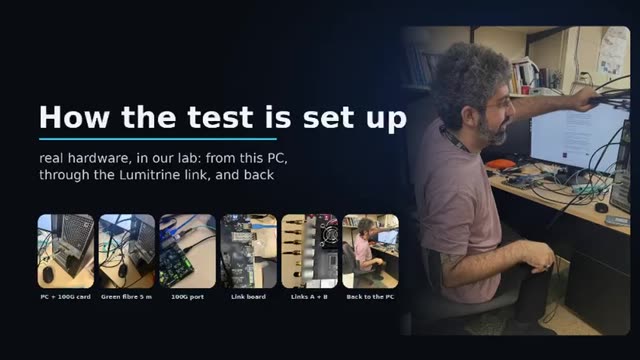
The live test, 3 minutes, with captions. Our engine, Lumitrine, is the core of NIOPTINET: six 4K movies, 16.1 GB in all, went from a normal PC through its two links and back.
3.2 µsdelay per link, one way, measured live
55.3Gb/s, two links together
2.7 sfor 16.1 GB of real files
6 of 6files identical after the trip

Lab bench, October 2026. On the bench the links run over short cables; real fibre spans come next, with pilot partners. The A1 Coherent below is the product for these links.

Short haul · the lowest latency · latency based

0.65 µs, and 16 GB in 3 seconds.

Metro fibre, 0.5 to 80 km, with no error correction. Six 4K movies through both links at every range; every copy arrives identical.

Live on our hardware, 76 seconds, with sound and captions. The fibre's signal quality at each range is emulated in the chip.
0.65 µsone way per link, measured with hardware timestamps
3 sfor 16.1 GB, 41.9 Gb/s of file data
0bits in error, with no error correction
80 kmevery copy identical at every range from 0.5 km
Short haul · fixed data rate

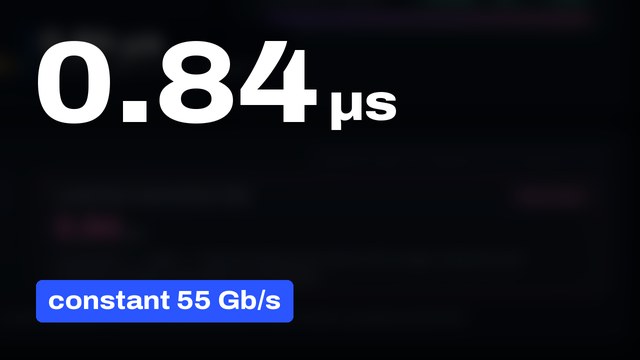
0.84 µs, at a constant 55 Gb/s.

One way per link at 30 km, with the line held at 55.3 Gb/s and error correction on: 0.83 to 0.85 µs at every range from 0.5 to 40 km, and 16.1 GB in 2.7 seconds at 30 km.

Live on our hardware, 85 seconds, with sound and captions.
0.84 µsone way at 30 km, measured live with the network card's clock
2.7 sfor 16.1 GB at 30 km, 47.3 Gb/s of file data
55.3Gb/s held on the line at every range, 0.5 to 40 km
6 of 6movies identical, no errors after the error correction
Products

A1 Metro, A1 Coherent and X1.

MEASURED · AVAILABLE FOR PILOTS

A1 Metro

A latency-first optical terminal for metro fibre, 0.5 to 80 km. Error-free with no error correction, or a constant 55 Gb/s with it.

Delay, one way per link0.65 µs latency-first (0.60 µs overclocked)
Capacity, latency-first43 Gb/s per unit on 2 wavelengths, no error correction
Capacity firstA constant 55.3 Gb/s at 0.78–0.88 µs, to 40 km
Reach40 km without amplifier, 80 km with one
Client and form100GbE QSFP28 · 19-inch, 2U
DESIGN · NOT BUILT YET

A1 Coherent

A coherent terminal for 80 to 400 km, where today's coherent terminals add 5 to 28 µs.3,5

Delay, one way per link0.5–0.75 µs to 80 km · 1.1–1.6 µs at 400 km
Capacity106 Gb/s per wavelength, up to 174 Gb/s capacity first
BasisOur link model; converter delay measured on our hardware
2027 · ESTIMATE

X1

The next generation: twelve times today's data rate in one unit, at today's measured latency.

Capacity at the lowest latency516 Gb/s at 0.65 µs, to 40 km
Capacity at the typical setting664 Gb/s at 0.78–0.88 µs
Client4 × 100GbE and 400GbE

Pick your distance.

The same A1 Metro at every range, measured on our bench with each distance's loss and noise added, 9 to 11 November 2026.

Up to 40 km: under 0.9 µs, at 43 or 55 Gb/s.

One way per link, both terminals, the fibre left out · log scale, 0.3 to 30 µs

Up to 40 km, no amplifier. 43 Gb/s per unit at 0.65 µs with no error correction (0.60 µs overclocked), or a constant 55.3 Gb/s at 0.78–0.88 µs.

60 to 120 km: 34 Gb/s at 0.69 µs.

One way per link, both terminals, the fibre left out · log scale, 0.3 to 30 µs

60 to 120 km. 34.4 Gb/s per unit at 0.69 µs with no error correction (0.63–0.64 µs overclocked to 80 km). One amplifier to 80 km.

200 to 500 km: still under 0.9 µs.

One way per link, both terminals, the fibre left out · log scale, 0.3 to 30 µs

200 to 500 km, amplified. 25.8 Gb/s at 0.74 µs at 200 km; 17.2 Gb/s at 0.86–0.87 µs from 300 to 500 km.

The fibre itself adds 4.9 µs per km, the same for everyone. Delay from hardware timestamps on 256-byte probes, the standard 100G loop taken out. Published figures: see sources.

Where we are

Core engineWorking in hardware
Short haul, latency based0.65 µs per link, measured
Short haul, fixed data rate55.3 Gb/s at 0.83–0.85 µs, measured
Coherent and long haul3.2 µs today; next board target ≈1.6 µs
Pilot partnersChoosing a few now

Sources for the published figures

  1. Cisco, 400G Digital Coherent Optics QSFP-DD Optical Modules Data Sheet: round-trip latency at 400GE of 4.7 µs (400G ZR+, QDD-400G-ZRP-S) and 7.9 µs (400G ZR, QDD-400G-ZR-S). cisco.com
  2. Zayo, New Jersey Triangle route overview, round-trip latencies: NYSE to NY4 is 374 µs on dark fibre, 376 µs on a 10G wave and 382 µs on a 100G wave; on the other routes a 10G wave adds 0 to 1 µs and a 100G wave 6 µs. The delay a carrier wave adds per link, one way, is half the difference: up to 1 µs (10G) and 3 to 4 µs (100G). zayo.com (PDF)
  3. Smartoptics, TQD013-TUNC-SO 400G ZR/ZR+ QSFP-DD data sheet: latency 5 µs (400G oFEC) to 11 µs (100G oFEC). smartoptics.com (PDF)
  4. ADVA Optical Networking (now Adtran), "Low latency for DCI and mobile applications: why and how?", 2019: 100G OTN with soft-decision FEC 15.24 µs, and 11.44 µs with fewer decoder iterations. adtran.com (PDF)
  5. Cisco, NCS 2000 400 Gbps XPonder Line Card Data Sheet: latency end to end 28 µs (100GE, SD-FEC 15%). cisco.com

AI Atlas figures are measured on our bench, 9 to 11 November 2026: hardware timestamps on 256-byte probes, one way per link, the fibre left out. Every delay on this page is what the terminals add; the fibre itself adds 4.9 µs per km for everyone.

Test NIOPTINET on your link.

A mutual NDA comes first. Then a short test plan, our bench, and your link.